
How to Get an FBI Background Check Apostilled for Use Abroad
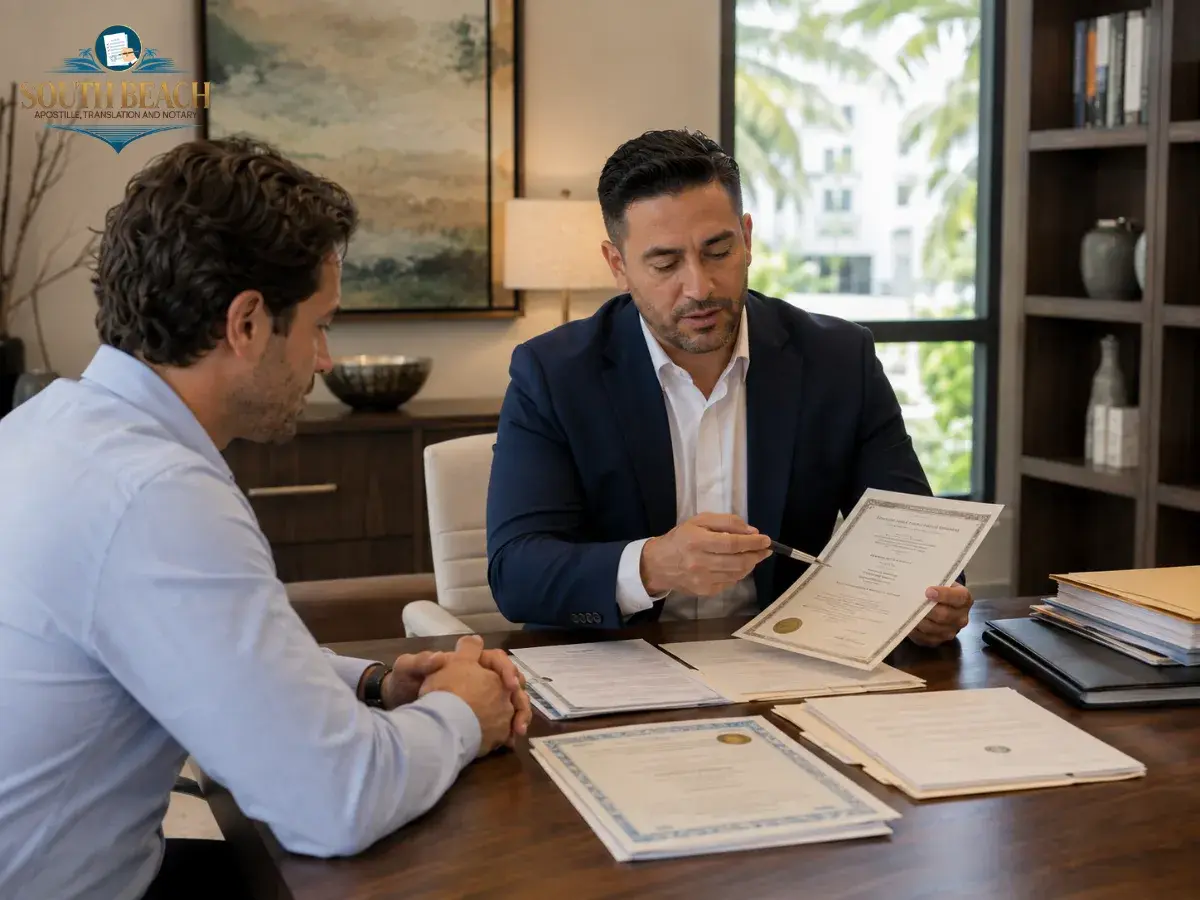
Quick answer: To use an FBI background check abroad, first complete the fingerprint submission required for an FBI Identity History Summary. After the FBI issues the authenticated record, confirm the destination country's rules. If the country participates in the Hague Apostille Convention and the receiving authority requires an apostille, the U.S. Department of State handles the federal apostille. If the country is outside the Convention, authentication and embassy or consular legalization may be required. Complete translation in the recipient's required sequence.
An FBI background check is a federal document. The Florida Department of State does not apostille it. Sending the record to a state apostille office can cause delay.
South Beach Apostille Translation & Notary can help coordinate the connected stages, including FBI fingerprinting in Miami, federal apostille assistance, and the appropriate translation service. The government and receiving authority still control their requirements, processing, and acceptance.
The five-step path: fingerprints, FBI Identity History Summary, destination-country review, federal apostille or authentication, then translation when required.
Why Foreign Governments Request FBI Background Checks
Foreign governments, consulates, employers, schools, licensing bodies, and adoption authorities may request an FBI background check to review an applicant's U.S. criminal-history information or confirm that no FBI identity history was found. Common purposes include residency, long-stay visas, citizenship, overseas employment, international adoption, education, and professional licensing.
The receiving authority sets the acceptable record, issue-date limit, authentication route, and translation standard. A local police or state record is not automatically a substitute for an FBI Identity History Summary.
Step 1: Complete the Required Fingerprint Submission
An FBI Identity History Summary is based on fingerprints. Current FBI guidance describes direct electronic requests with fingerprints submitted at a participating U.S. Post Office, requests through an FBI-approved channeler, and mailed requests using a current fingerprint card.
The exact card and process matter. For a personal Identity History Summary, review the FBI's current Identity History Summary instructions. Do not assume that every FBI-related request uses FD-258. The FBI publishes FD-1164 for personal Identity History Summary fingerprinting, while FD-258 remains an applicant card used for other civil or agency-specific submissions. Our guide to Live Scan versus FD-258 fingerprinting compares the two formats in detail.
Bring valid photo identification and the complete instructions for the selected route. Clear fingerprint capture matters, but accurate names, dates, applicant data, form fields, and submission references are also essential. If the foreign authority gave you a special instruction, include it in the review before capture.
Watch: FBI Background Checks for International Use
In this short South Beach video, the fingerprinting specialist explains that fingerprint capture is only the first stage. The completed FBI record may later need a federal apostille, authentication, or translation before it is submitted abroad.
Step 2: Obtain the FBI Identity History Summary
Submit the request, fingerprints, applicant information, and payment according to the selected FBI or channeler process. The FBI issues the Identity History Summary to the applicant or through the approved route. The summary may show fingerprint-submission information associated with the individual, or it may report that no Identity History Summary exists.
The FBI states that it authenticates fingerprint search results with an FBI watermark and the signature of a division official. That authentication is what allows the resulting federal record to move to the U.S. Department of State for an apostille when necessary. The FBI itself does not issue the apostille.
Step 3: Determine the Destination Country and Receiving Authority
Name the destination country and receiving organization before ordering the apostille or translation. Hague Convention participation determines the general route, but the recipient may impose additional document and translation requirements.
Confirm the application type, issue-date limit, acceptable record format, and whether the apostille page must be translated. Requirements can differ within one country because visa, citizenship, and licensing processes are separate.
Step 4: Federal Apostille vs. Authentication
The U.S. Department of State Office of Authentications issues both apostille certificates and authentication certificates for federal documents. The destination country determines which certificate applies.
| Destination | Federal document path | Possible next step |
|---|---|---|
| Hague Convention country | U.S. Department of State apostille for the eligible FBI record | Translation or other recipient-specific step, if required |
| Non-Hague country | U.S. Department of State authentication | Embassy or consular legalization may follow |
Check the current country status using the HCCH Apostille Convention status table and review the U.S. Department of State Office of Authentications instructions before submission. Do not rely on an old country list or assume that every non-Hague process ends after federal authentication.
Step 5: Determine Whether Translation Is Required
The receiving authority decides whether the FBI record, the apostille or authentication certificate, and any supporting pages must be translated. It may also specify who may translate the document, the certification wording, formatting, signatures, stamps, or delivery format.
Confirm the requirement before translation begins. Translating too early can create duplicate expense if the apostille must be included, while the wrong translator type can require correction.
Certified Translation
A certified translation is accompanied by a signed certification statement confirming that the translation is complete and accurate. This format is commonly used by U.S. institutions and may also be accepted abroad when the receiving authority allows it. Review South Beach's certified translation services.
Sworn Translation
A sworn translation is completed or certified by a translator officially authorized under a particular country's system. It is common in jurisdictions where courts, ministries, civil registries, or immigration authorities require a country-recognized translator. South Beach can coordinate international sworn translation services based on the country and document use.
Neither label should be treated as universally acceptable. Ask the receiving authority whether it requires a certified translation, a sworn translator, a consular translator, notarization of the translator's statement, or another country-specific format.
FBI Background Check Apostille for Spain
Spain is a Hague Apostille Convention country, so an eligible FBI background check used there generally follows the federal apostille route through the U.S. Department of State. Current Spanish consular guidance for certain visa categories states that U.S. criminal-record certificates must be FBI records, apostilled, and translated into Spanish. Some consular instructions specifically call for an official or sworn translation.
Requirements still vary by visa type and consular district. For example, the Consulate General of Spain in New York's current student-visa guidance requires the relevant criminal record to be legalized or apostilled and translated into Spanish. Confirm the current checklist for the consulate or Spanish authority handling your application before ordering services.
Hague vs. Non-Hague Destination Countries
For a Hague destination, the apostille generally replaces further diplomatic legalization for the covered public document. For a non-Hague destination, the authentication chain may continue to an embassy or consulate. Political changes, accessions, objections, and territory-specific rules can affect the route, so verify current status for the exact destination rather than using a generic list.
Common Mistakes That Delay International Use
- Sending the FBI record to the Florida Secretary of State instead of the U.S. Department of State.
- Obtaining a state or local police record when the foreign authority specifically requires an FBI record.
- Using the wrong fingerprint form or request route for the intended FBI product.
- Failing to confirm the destination country, receiving authority, or document-age limit before ordering services.
- Ordering translation before confirming whether the apostille must also be translated.
- Using a standard certified translation when the destination requires a sworn or officially authorized translator.
- Removing staples, altering pages, or separating a completed authentication package contrary to the recipient's instructions.
- Assuming expedited service guarantees an agency, embassy, consulate, or foreign authority deadline.
How South Beach Can Coordinate the Full Process
South Beach Apostille Translation & Notary can coordinate several connected services through one Miami Beach team: fingerprint capture, guidance on the requested FBI-record route, federal apostille or authentication assistance, certified translation, country-specific sworn translation, and document return or delivery coordination when available.
Led by Gabriel Albelo, the bilingual English and Spanish team brings more than 25 years of document-service experience. The country, record type, authentication route, translation standard, and deadline can be reviewed as one connected package.
Written translation and live language support are different services. If a client also needs spoken-language assistance for an appointment or meeting, ask separately about interpretation services. Interpretation does not replace legal advice or the receiving authority's official requirements.
South Beach is a private service provider. It is not the FBI, the U.S. Department of State, the Florida Department of State, an embassy, a consulate, or another government authority. It cannot issue government decisions, change agency processing times, or guarantee acceptance.
Start Your FBI Background Check Apostille in Miami Beach
Before booking, gather the destination country, receiving authority, application type, deadline, and any written checklist. If you already have the FBI result, send a clear copy for preliminary review and keep the original package intact.
Call 786-970-0450 or request a quote from South Beach Apostille Translation & Notary. The office is located at 900 West Ave #601, Miami Beach, FL 33139, with service support for clients throughout Miami-Dade, South Florida, and beyond.
Frequently Asked Questions
Who apostilles an FBI background check?
The U.S. Department of State handles apostilles for eligible federal documents such as FBI-authenticated fingerprint search results. The Florida Secretary of State does not apostille federal FBI records.
Does the FBI issue the apostille?
No. The FBI authenticates its fingerprint search results with the FBI watermark and an official signature. The applicant may then send the authenticated federal record to the U.S. Department of State for an apostille when necessary.
Do I need fingerprints for an FBI background check for use abroad?
Yes, an FBI Identity History Summary is based on fingerprint submission. Follow the current FBI, approved-channeler, or requesting-authority instructions for the exact fingerprint form and submission method.
How long does an FBI background check apostille take?
Total timing depends on fingerprint capture, the FBI request route, current U.S. Department of State processing, shipping, corrections, and translation. Ask for current estimates, but do not treat an estimate as a government guarantee.
Does an FBI background check need notarization before apostille?
Generally, an FBI Identity History Summary is already authenticated by the FBI for the federal process and is not notarized as a substitute. Follow the U.S. Department of State and receiving authority instructions for the record you received.
What do I need for an FBI background check apostille for Spain?
For many Spanish visa and residency workflows, applicants are instructed to obtain an FBI record, a federal apostille from the U.S. Department of State, and a Spanish translation. The exact issue-date and translation requirements vary by application and consulate, so confirm the current checklist.
Should the apostille page also be translated?
That depends on the receiving authority. Some authorities require translation of the record and apostille, while other instructions differ. Confirm the required scope before the translator begins.